
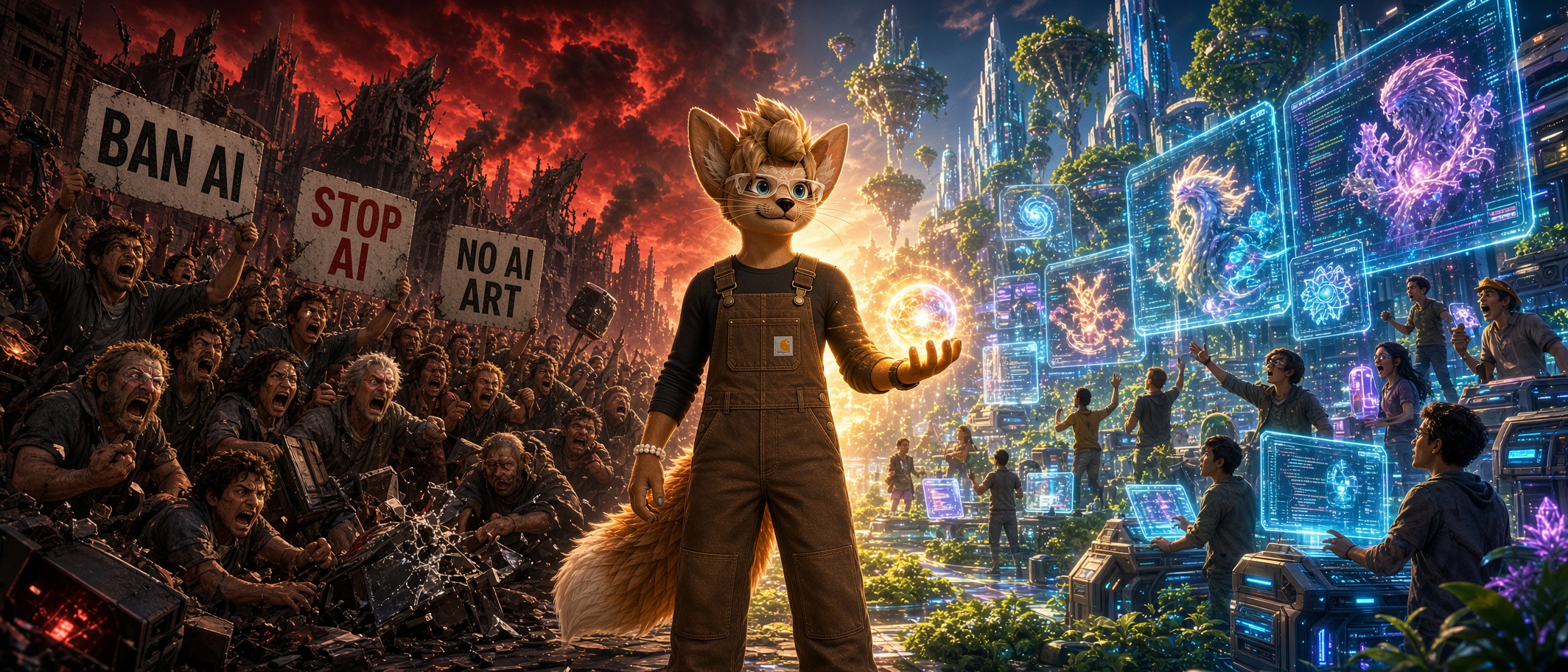
As artificial intelligence transforms the creative landscape, a cultural divide is emerging between those determined to resist it and those discovering an extraordinary new world of possibilities. But the path toward acceptance may have less to do with winning arguments and more to do with changing minds, one person at a time.
By Isaac | November 1, 2026
---
There is something extraordinary happening behind the noise of the artificial intelligence debate.
While social media platforms fill with arguments, accusations, boycotts, and increasingly heated declarations about the dangers of AI, another group of people is having an entirely different experience.
They're building.
They're experimenting.
They're solving problems that once seemed impossibly complicated.
And perhaps most importantly, they're having an incredible amount of fun doing it.
The contrast is becoming difficult to ignore.
On one side of the debate are people who see artificial intelligence as an existential threat to creativity, employment, artistic identity, and human achievement.
On the other are people who have discovered that these same technologies can dramatically expand what an individual or small team can accomplish.
For those working directly with increasingly sophisticated AI systems, the conversation has moved far beyond whether artificial intelligence should exist.
The question has become something considerably more interesting:
What can we build now that we couldn't build yesterday?
And the answers are arriving faster than many people can comprehend.
A Different Kind of Creative Revolution
Consider what happens when a small group of developers, engineers, and creative thinkers begins working with multiple artificial intelligence systems simultaneously.
This is no longer simply a matter of opening a chatbot and asking it to write a few lines of code.
The emerging workflows are considerably more sophisticated.
Developers are constructing AI agent harnesses, creating connectors between otherwise incompatible systems, building context-management frameworks, and designing orchestration systems that allow multiple specialized AI agents to work together.
One agent might examine an existing codebase and identify architectural problems.
Another might develop a proposed solution.
A third might construct tests, investigate failures, or review the implementation for potential weaknesses.
Meanwhile, human developers supervise the process, make architectural decisions, resolve disagreements between systems, and determine which solutions actually deserve to become part of the finished product.
The result can be a remarkable acceleration of the development process.
Problems that previously required hours of research can sometimes be investigated in minutes.
Ideas that might once have remained abandoned in a notebook can become functional prototypes in a single evening.
Entire systems can be assembled, tested, revised, and expanded through an iterative process that feels fundamentally different from traditional software development.
Not every generated solution works. AI agents make mistakes, misunderstand requirements, and sometimes introduce new problems while attempting to solve existing ones.
But increasingly capable tools, combined with carefully designed workflows and human oversight, are changing the economics of experimentation.
The cost of trying something ambitious is falling.
And when experimentation becomes cheaper, the number of ideas worth exploring increases dramatically.
What Happened Last Night
I experienced this firsthand.
Last night, I found myself working alongside a team of people, building systems at a pace that would have seemed almost ridiculous only a few years ago.
We were creating functionality, discovering bugs, solving problems, connecting different technologies, and watching increasingly complex systems come together.
The workflow was extraordinary.
Multiple AI agents were participating in different parts of the development process. Context systems helped maintain continuity. Connectors allowed separate technologies to communicate. Agent harnesses provided structure around the work.
We weren't simply asking AI to do things.
We were designing environments in which humans and AI systems could collaborate on increasingly complicated problems.
One discovery would lead to another.
A solution would reveal a new opportunity.
A new opportunity would inspire another experiment.
And before long, something that had started as a relatively simple idea had grown into a much larger technical achievement.
There was an unmistakable sense of momentum.
The most remarkable part wasn't simply how quickly things were happening.
It was how much I was enjoying the process.
I spent hours working because I wanted to.
Not because someone was demanding another feature.
Not because a deadline was approaching.
Not because I had been assigned some tedious technical obligation.
I was genuinely fascinated by what we were accomplishing.
Every successful integration opened another door.
Every solved problem created another possibility.
Every new capability made me wonder what else we could build.
There is a particular kind of excitement that comes from watching an idea become reality.
AI-assisted development has amplified that experience in ways I never expected.
And I know I'm not the only person experiencing it.
Across software development, digital art, animation, virtual reality, music, engineering, and countless other creative disciplines, people are discovering workflows that dramatically change their relationship with the tools they use.
For many of us, this isn't the destruction of creativity.
It feels like an explosion of it.
Two Communities Experiencing Two Different Realities
The growing conflict surrounding artificial intelligence becomes easier to understand when we recognize that the opposing sides are often experiencing fundamentally different realities.
For someone who has spent years developing traditional artistic skills, AI-generated content can feel threatening.
A person who invested thousands of hours learning illustration, animation, programming, or another specialized discipline may understandably question what happens when software can reproduce certain results in seconds.
There are legitimate concerns about copyright, compensation, consent, employment, and the economic consequences of automation.
Those questions deserve serious consideration.
But there is also a more confrontational movement that has transformed opposition to AI into something resembling a cultural identity.
Within some online communities, simply admitting to using AI can provoke hostility.
Creators are accused of cheating.
Developers are dismissed as incompetent.
Artists who incorporate generative tools into their workflows are told their work has no value.
In more extreme cases, arguments become harassment campaigns, attempts at public humiliation, and demands that communities exclude anyone associated with the technology.
This hostility creates an environment in which people become reluctant to discuss the tools they're using.
And that produces a strange contradiction.
While some communities are spending enormous amounts of energy arguing about whether AI-assisted creativity should be permitted, others are quietly discovering what it makes possible.
One group is debating the legitimacy of the tools.
The other is learning how to use them.
The difference in practical experience grows with every passing month.
The Quiet Builders Are Moving Faster
There is an important distinction between criticizing a technology and refusing to understand it.
Criticism can improve technology.
It can expose weaknesses, identify ethical problems, and force developers to address consequences they might otherwise overlook.
But criticism becomes less useful when it turns into an absolute rejection of experimentation.
The people embracing AI are not necessarily abandoning traditional skills.
Many are applying those skills in new ways.
Experienced programmers still need to understand architecture, security, performance, and maintainability.
Artists still need composition, taste, visual judgment, and creative direction.
Engineers still need to understand physical constraints, reliability, and the consequences of failure.
AI does not automatically eliminate these responsibilities.
In many situations, it increases the importance of human judgment because the volume of potential output becomes so much greater.
A developer who previously wrote every function manually may now spend more time designing systems, reviewing implementations, and coordinating specialized agents.
An artist who once spent days developing a preliminary concept may now explore dozens of variations before selecting a direction worth refining.
A small creative team may be able to attempt projects that previously required far more people, money, or time.
These capabilities do not guarantee quality.
They do, however, expand the range of possibilities.
And that expansion is precisely what makes the technology so exciting.
We are not simply producing the same things faster. We are discovering that some things previously beyond our reach are now achievable.
The Fear Is Real, but So Is the Opportunity
It would be a mistake to assume everyone resisting AI is motivated by jealousy, ignorance, or hostility.
Some people have genuine reasons to worry.
The technology is advancing quickly, and its economic and social consequences remain uncertain.
Artists want assurance that their work will not be exploited without appropriate consideration.
Workers want to know whether their professions will remain viable.
Communities want to preserve the human relationships and traditions that give their creative spaces meaning.
These concerns cannot simply be dismissed.
But neither should they become an excuse to deny the experiences of people who are finding tremendous value in the technology.
The same tool that threatens to disrupt one person's established workflow may allow another person to pursue a creative ambition that was previously impossible.
A programmer with limited artistic ability may finally be able to visualize a game concept.
An artist with little programming experience may be able to build an interactive experience.
A small community organizer may create tools that would otherwise require a dedicated software team.
Someone with a disability may find that AI removes barriers that previously prevented them from participating fully in a creative activity.
A person with limited financial resources may gain access to capabilities that were once reserved for organizations with substantial budgets.
These are not hypothetical categories of opportunity.
They reflect the kinds of applications already being explored across the technology landscape.
The important question is not whether AI has consequences.
Every major technological transformation does.
The question is whether society can address those consequences without unnecessarily restricting the opportunities that make the technology valuable.
Creativity Was Never Supposed to Be a Competition in Suffering
One of the more troubling arguments surrounding AI-assisted creativity is the suggestion that the difficulty of producing something determines its artistic legitimacy.
Under this reasoning, a creative work becomes less valuable if technology reduces the labor required to produce it.
But creativity has never been defined exclusively by how difficult a tool is to operate.
Photography did not eliminate the artistic value of painting.
Digital illustration did not eliminate traditional drawing.
Computer-aided design did not eliminate engineering.
Music production software did not eliminate musicianship.
Each technological transition changed the relationship between human intention and technical execution.
Some traditional skills became less commercially essential.
Other skills became more important.
Entirely new creative disciplines emerged.
Artificial intelligence is likely to produce similarly complicated changes, although its breadth and speed make the current transition unusually disruptive.
The central question remains the same.
Does the person using the tool have something meaningful they want to create?
Do they exercise judgment?
Do they make decisions?
Do they contribute ideas, direction, interpretation, and purpose?
If so, the creative process has not necessarily disappeared.
It has changed.
And for many people, that change is liberating.
I don't want to spend three weeks fighting a technical limitation if I can solve it in an evening and move on to the next creative challenge.
I don't want an idea to remain permanently unfinished because I lack one specialized skill.
I want to explore.
I want to experiment.
I want to build.
And increasingly, I can.
The Debate Is Missing the Most Important Human Experience
There is something strangely absent from much of the public argument about artificial intelligence.
Joy.
The simple pleasure of discovering something new.
The excitement of watching a difficult problem finally become solvable.
The satisfaction of collaborating with other people on a project that grows beyond anyone's original expectations.
These experiences matter.
When I describe spending entire nights working with AI systems, I am not describing someone reluctantly surrendering their creativity to a machine.
I'm describing someone having an extraordinary time creating things.
The technology has not made me less interested in programming.
It has made me more interested.
It has not eliminated my desire to understand complicated systems.
It has given me more complicated systems to explore.
It has not reduced my ambitions.
It has expanded them.
That distinction deserves more attention than it receives.
Because when someone insists that AI is destroying creativity, they are making a claim that conflicts directly with the lived experience of people who feel more creatively empowered than ever before.
Both experiences can exist.
A technology can disrupt one person's livelihood while expanding another person's opportunities.
Recognizing that complexity is essential.
But telling enthusiastic creators that their excitement is illegitimate will not make their experiences disappear.
We Cannot Argue Everyone Across the Bridge
There is a temptation among people enthusiastic about artificial intelligence to believe that enough demonstrations, explanations, and technical evidence will eventually convince everyone.
I no longer believe acceptance will happen that way.
Some people have built such a strong personal identity around opposing AI that changing their position publicly would carry a social cost.
Others have legitimate concerns that cannot be resolved through a product demonstration.
And some simply have no interest in using the technology.
That is their choice.
The mistake is assuming that broad cultural acceptance must happen through a single collective decision.
It doesn't.
The bridge between fear and opportunity will not be crossed by an entire crowd at once.
It will be crossed by individuals.
One person at a time.
And most of those people will not cross because someone defeated them in an argument.
They will cross because something changes in their own experience.
A frustrating task becomes easier.
A creative limitation disappears.
A problem that once seemed impossible suddenly becomes manageable.
A project they abandoned years ago becomes achievable.
A tool helps them accomplish something that genuinely matters to them.
And for a moment, the ideological debate becomes less important than the practical result.
That is where attitudes begin to change.
Not through humiliation.
Not through demands for ideological surrender.
Not through insisting that someone abandon every concern they previously held.
But through usefulness.
Through personal discovery.
Through an experience that gives someone a reason to reconsider.
Building Bridges Without Demanding Agreement
The most effective bridge between these communities may be one that nobody is required to cross.
People should be free to create without AI.
They should be free to prefer traditional workflows.
They should be free to criticize the technology and advocate for reasonable safeguards.
And people who embrace AI should have the same freedom to experiment, innovate, and pursue their creative ambitions.
These positions do not have to be mutually exclusive.
A healthy creative community can accommodate different tools, different philosophies, and different approaches to producing meaningful work.
What it cannot sustain indefinitely is a culture in which disagreement automatically becomes hostility.
If someone believes AI-assisted work is inferior, they are free to demonstrate the value of their preferred methods.
If someone believes AI expands creative opportunity, they should be free to demonstrate that value through what they build.
The work itself becomes part of the conversation.
And over time, practical examples can accomplish something that arguments rarely achieve.
They make unfamiliar possibilities understandable.
A person who rejects AI in the abstract may eventually discover a specific application that helps them.
Perhaps it will be accessibility.
Perhaps it will be programming.
Perhaps it will be translation, animation, research, or some entirely unexpected application.
The reason doesn't matter nearly as much as the discovery.
People rarely change their minds because someone demands it. They change their minds when new experiences give them a reason to.
That is why the goal should not be to win over an angry crowd.
It should be to create opportunities for individual people to discover value for themselves.
The Future Is Being Built While the Argument Continues
There is another reality that deserves recognition.
Technological development does not stop simply because public opinion remains divided.
AI models continue to improve.
Agent frameworks continue to evolve.
New integrations, development environments, and creative applications continue to appear.
The tools available today are already different from those available a year ago.
And the capabilities emerging from combinations of these systems are becoming increasingly sophisticated.
That does not mean progress is inevitable in every direction, or that every application deserves adoption.
It means the practical landscape is changing whether individual communities approve of that change or not.
People who choose to experiment are accumulating experience.
They're discovering which workflows succeed and which fail.
They're learning where human supervision matters most.
They're building infrastructure that makes future experimentation easier.
And they're developing an understanding of the technology that cannot be acquired solely through arguments about it.
This growing body of practical knowledge may ultimately prove more influential than the loudest voices on either side of the debate.
Because technological adoption is rarely determined exclusively by public enthusiasm.
It is also shaped by whether a tool solves real problems.
And right now, a growing number of people are discovering that AI solves problems they care about.
While They Rage, We Create
I keep returning to the experience of last night.
A group of people working together.
Multiple AI systems participating in a coordinated development process.
Bugs appearing and disappearing.
Ideas evolving into functioning systems.
Technical obstacles becoming opportunities to learn something
Comments