
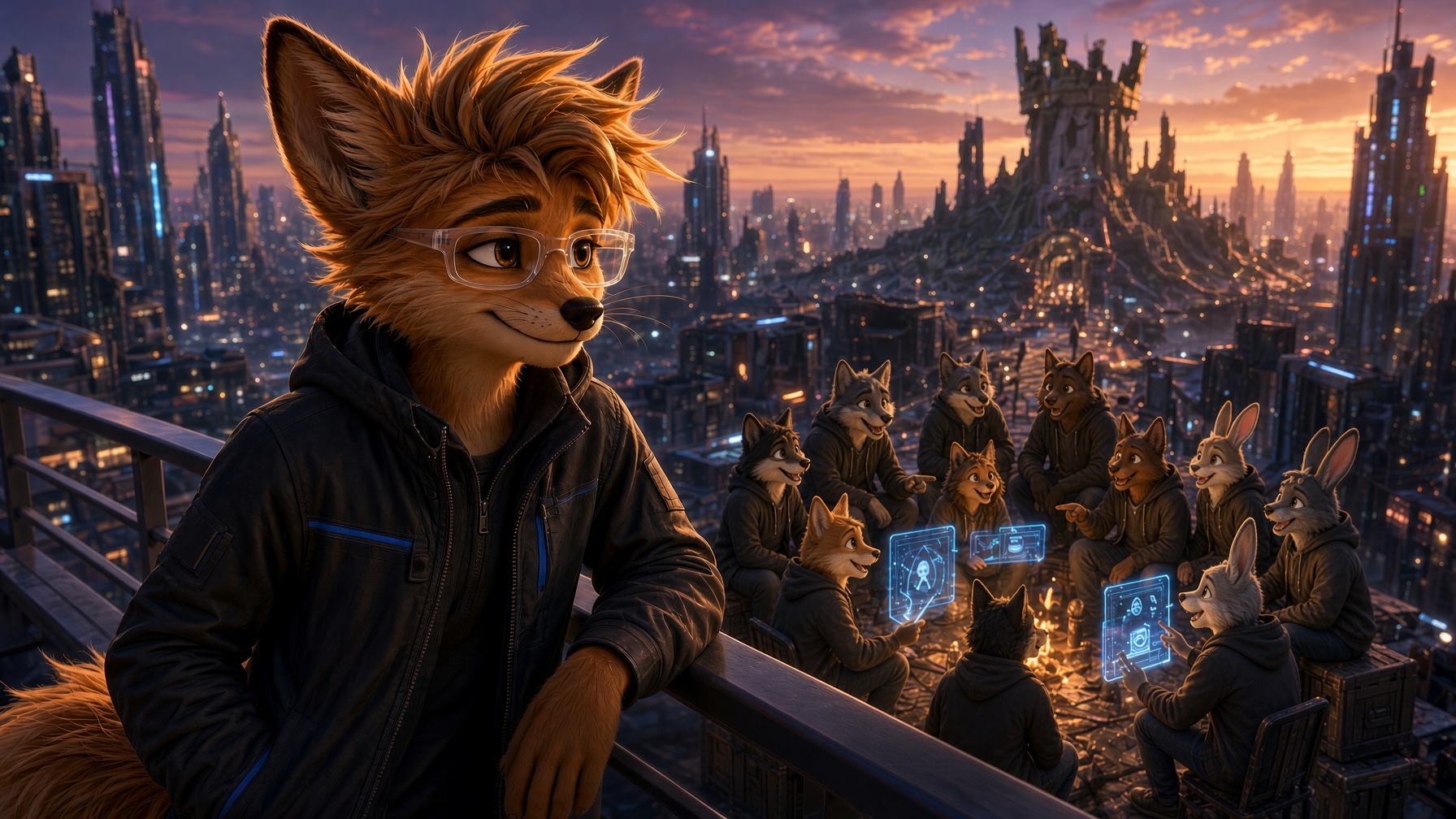
Opinion | After years of building virtual spaces, organizing events, and bringing people together, I've come to question whether growth is really the best measure of a community's success.
For much of my life, I've been fascinated by what happens when people come together to build something.
Not because someone is paying them. Not because they're obligated to participate. But because they have an idea, a shared interest, or a desire to accomplish something that would be difficult to achieve alone.
There's something remarkable about that kind of cooperation.
A programmer meets an artist. An engineer meets a musician. Someone with an ambitious idea meets someone who knows how to make it possible. Before long, a handful of people who might never have encountered one another are creating experiences that none of them could have imagined independently.
I've spent years trying to make those moments happen.
Through virtual reality, online communities, and collaborative projects, I've invested an extraordinary amount of my time, energy, and personal resources into creating environments where people could meet, experiment, and build.
For a long time, I believed the natural measure of success was growth.
If we could bring more people together, we could create bigger experiences. If we could create bigger experiences, we could attract more talented people. And if enough people participated, perhaps we could build something genuinely extraordinary.
It seemed like a perfectly reasonable ambition.
And in many ways, it worked.
But somewhere along the way, I began to discover that the pursuit of growth was changing my relationship with the very thing I loved.
Today, after years of successes, failures, friendships, disagreements, and difficult lessons, I find myself arriving at a conclusion that would have seemed almost unthinkable to me earlier in life.
I don't need my community to become massive anymore.
And strangely enough, accepting that has brought me more peace than growth ever did.
The Dream of Building Something Bigger
When you start a community, particularly one centered on creativity and technology, the possibilities can seem almost limitless.
Every new member represents another potential connection. Every event introduces people who might discover a shared interest. Every successful project demonstrates what becomes possible when people coordinate their abilities.
I wanted to cultivate that.
I wanted a place where technical knowledge was shared openly, where people could experiment without feeling embarrassed about failure, and where ambitious ideas weren't immediately dismissed because they seemed impractical.
I wanted people to have opportunities.
And because I had the technical background and resources to make certain things possible, I often found myself building the infrastructure that supported those ambitions.
Servers, websites, networking systems, streaming platforms, event technology, software, and all the countless pieces of equipment and engineering that make virtual experiences work.
Much of that work happened quietly, behind the scenes.
People would arrive, enjoy an experience, make friends, and leave with memories. They didn't necessarily need to understand the systems that made it possible.
That was part of the satisfaction.
When something works well, the people enjoying it shouldn't have to think about how complicated it was to build.
But as our ambitions expanded, so did the responsibility.
Projects became larger. Events became more complicated. Expenses increased. Expectations grew.
And eventually, I found myself confronting a question I hadn't seriously considered when I started.
At what point does building something for people become an obligation to keep making it bigger?
The Hidden Cost of Success
Growth is frequently celebrated as an unquestionable good.
Businesses pursue more customers. Social platforms pursue more users. Creators pursue more followers. Online communities pursue more members.
We have become accustomed to treating expansion as evidence that something is working.
But growth also changes the nature of an organization.
A small group of friends can make decisions through casual conversations. A large community must accommodate people with different expectations, different personalities, and different ideas about what the community should become.
Neither situation is inherently better.
But they are fundamentally different.
As a community expands, the amount of effort required to coordinate people can grow alongside it.
What once required a conversation between friends may become a lengthy discussion about expectations, responsibilities, fairness, and competing priorities.
The technical challenges become more complicated. The financial commitments become larger. The consequences of mistakes become more significant.
And the person who originally wanted to create something can gradually find themselves spending more time administering it than enjoying it.
I experienced that transition firsthand.
There were periods when I felt that the original creative purpose of what I was building had become increasingly difficult to preserve.
I was spending more money, managing more responsibilities, and navigating more complicated social expectations.
Ideas that once excited me sometimes became exhausting to pursue.
And I began to recognize that I had allowed the size of the community to become a responsibility I carried personally.
That was an important mistake.
A community is not a machine that must continually expand to justify its existence.
It is a collection of people who have chosen, for their own reasons, to participate in something together.
And those reasons will not always remain the same.
The Difficulty of Sharing a Vision
One of the hardest lessons I've learned is that people can genuinely care about the same community while having very different ideas about what it should become.
Some value stability. Others value experimentation.
Some prefer carefully organized experiences. Others thrive in environments where people can improvise and make mistakes.
Some want large public events. Others simply want a comfortable place to spend time with friends.
These differences are not necessarily evidence that anyone is acting in bad faith.
They're evidence that people are different.
And the larger a community becomes, the more difficult it is to reconcile those differences.
For someone who has invested years into building a particular vision, that can be especially challenging.
When you've spent your own money, sacrificed your own time, and personally maintained the systems that support a project, it's easy to become deeply attached to the direction you believe it should take.
I certainly did.
There were times when I felt that my ideas were being diluted or that the original purpose of our work was becoming secondary to social expectations.
There were disagreements about priorities, responsibilities, and how things should operate.
Some of those disagreements were painful.
Some relationships changed. Some people moved on. Some experiences left lasting frustration.
I don't intend to revisit individual disputes here, because the larger lesson isn't about assigning blame.
It's about recognizing that a shared community does not guarantee a shared vision forever.
People change.
Their interests change.
Their priorities change.
And sometimes the healthiest outcome is allowing those differences to exist without demanding that everyone arrive at the same conclusion.
I've come to believe that trying to preserve a community through constant pressure can ultimately damage the very relationships that made it worth creating.
When the Place You Love Becomes Exhausting
There is another consequence of prolonged community conflict that deserves more attention.
It can change how you experience a place.
Virtual reality was once something I looked forward to with tremendous excitement.
The technology fascinated me. The possibilities seemed endless. Every new environment represented another opportunity to discover something remarkable.
I loved the unpredictability of it.
You could log in expecting an ordinary evening and end up meeting someone who would become a close friend, discovering an extraordinary world, or stumbling into a conversation that inspired your next project.
That sense of possibility was intoxicating.
But after enough difficult experiences, I began associating those same environments with responsibilities and unresolved social tensions.
Instead of wondering what interesting thing I might discover, I sometimes found myself wondering what problem I might encounter.
Instead of thinking about the next exciting project, I was thinking about the consequences of previous ones.
And that realization bothered me.
I had spent years building systems intended to help people enjoy virtual reality, yet my own enjoyment of it was suffering.
There is something profoundly counterproductive about that.
A creative environment should not require its participants to remain permanently engaged in its history of disagreements.
People need room to change, to pursue new interests, and to move beyond circumstances that no longer serve them.
That includes the people who founded those communities.
And it includes the people who eventually choose to leave them.
Learning That People Are Free to Leave
For years, I felt a personal responsibility to maintain momentum.
If participation declined, I wanted to understand why.
If an event struggled, I wanted to improve it.
If people lost interest, I wondered what I could do to bring them back.
Those instincts can be useful when you're organizing something.
But taken too far, they can become an unhealthy way to measure your own accomplishments.
You begin interpreting natural changes in participation as problems that require intervention.
A person spending time elsewhere starts to feel like a loss.
A smaller event starts to feel like a failure.
And a community that isn't expanding starts to feel like it's dying.
I've stopped looking at it that way.
People should be free to come and go.
They should be able to explore other communities, develop new friendships, pursue different interests, and make decisions about how they want to spend their time.
They should not have to justify those choices to me.
And I shouldn't feel obligated to continually reinvent an entire organization to convince them to stay.
That doesn't mean I value their participation any less.
Quite the opposite.
When someone participates because they genuinely want to, their presence means more than any membership statistic ever could.
I would rather have a handful of people enthusiastically building something together than hundreds participating out of obligation, expectation, or social pressure.
There is freedom in that realization.
For them, and for me.
Why Kindness Still Matters
Throughout my experiences, I've continued returning to a principle that sounds almost embarrassingly simple.
Be kind.
I say it frequently.
And I understand why some people might find that frustrating, particularly when they have seen me become angry, stubborn, or confrontational.
I'm not claiming to be a perfect example of the principle I advocate.
I've lost my patience. I've argued. I've made decisions that others disagreed with. I've sometimes struggled to separate my frustration from the larger issues I was trying to address.
But kindness was never supposed to be a claim of moral perfection.
It is something I believe we should actively choose.
And I believe in it because I've witnessed what becomes possible when people practice it.
I've seen extraordinary things happen when people stop treating one another as competitors for attention and begin recognizing one another as potential collaborators.
I've watched people teach complete strangers skills that took them years to develop.
I've seen artists, programmers, engineers, and performers come together to create experiences that none of them could have produced alone.
I've watched people contribute simply because they wanted someone else's idea to succeed.
Those moments matter to me.
They are the reason I keep building.
And they are why I find prolonged social hostility so wasteful.
Every hour spent maintaining an unnecessary feud is an hour that could have been spent learning something.
Every relationship reduced to a loyalty test is a potential collaboration that may never happen.
Every person treated as an enemy because of a disagreement represents another opportunity for understanding that has been lost.
Of course, kindness does not eliminate the need for boundaries or accountability.
People can disagree strongly. They can choose not to work together. They can decide that a particular environment is no longer right for them.
But none of those choices require turning every disagreement into a permanent campaign against another person's character.
We can do better than that.
The Illusion of Scarce Social Capital
One of the more troubling patterns I've observed in online spaces is the tendency to treat social influence as though it were a finite resource.
Attention becomes something to compete for.
Friendships become evidence of status.
Recognition becomes a measure of personal importance.
And another person's success can begin to feel like a threat to your own position.
I think that mentality is enormously destructive.
Creativity does not operate according to the same rules as a limited physical resource.
Someone else learning to program does not reduce my ability to write software.
Another artist becoming successful does not prevent someone else from creating something beautiful.
A neighboring community hosting an extraordinary event does not diminish the value of our own experiences.
In fact, those accomplishments can make the entire environment more interesting.
When people share knowledge and celebrate one another's achievements, opportunities multiply.
New ideas emerge. Skills spread. Relationships develop.
But when everyone becomes preoccupied with their relative social standing, those possibilities begin to disappear.
Instead of asking what we could create together, people become concerned with who deserves recognition, who has influence, and who belongs in which social circle.
I've seen enough of that to know I don't want it to define my future.
I want to spend my time around people who are excited about what they can make, not preoccupied with where they rank.
A Different Kind of Leadership
I used to associate leadership with momentum.
A leader organized, expanded, recruited, coordinated, and continually pushed the organization toward something larger.
There is value in those skills.
But I've come to appreciate another form of leadership.
One that creates opportunities without requiring people to take them.
One that establishes a direction without demanding universal agreement.
One that recognizes that volunteers are individuals with their own ambitions, limitations, and priorities.
And one that understands that sometimes the best thing you can do is allow people to pursue what interests them.
I don't need to personally direct every project.
I don't need every member to participate in every event.
I don't need the community to organize itself around my expectations.
I can provide infrastructure, share knowledge, offer opportunities, and contribute to projects I find worthwhile.
Other people can do the same.
And if something extraordinary emerges from those independent efforts, that's wonderful.
If it doesn't, nobody has failed.
We still had the opportunity to create something together.
That should count for something.
Finding Peace in What Already Exists
Today, I find myself less interested in building a massive organization and more interested in the individual experiences that make communities worthwhile.
A few friends working on an unusual technical project.
Someone learning a new skill.
A spontaneous gathering in a virtual world.
An event that succeeds because a handful of people genuinely wanted to make it happen.
These things don't require enormous audiences.
They don't require complicated political structures.
They don't require constant expansion.
They require people who care enough to participate.
And that, I think, is what I was searching for all along.
I haven't abandoned my ambitions.
I still want to build remarkable things. I still want to explore new technologies, create experiences, and help people accomplish things they might not otherwise have believed possible.
But I no longer feel compelled to measure those ambitions against the size of the community surrounding them.
If something grows naturally, I'll welcome it.
If people move on, I'll respect that.
If the community becomes smaller, that doesn't mean the work was meaningless.
The relationships, experiences, and things we created still happened.
Their value doesn't disappear because the membership count changes.
The Freedom to Keep Creating
I don't know exactly what the future holds for the community I've spent so much of my life building.
And for once, I don't feel particularly anxious about that uncertainty.
There will be new people, new ideas, new friendships, and undoubtedly new disagreements.
Some projects will succeed. Others will fail.
Some people will stay for years. Others will pass through briefly before finding something that better suits them.
That's how communities work.
They are not static monuments to the ambitions of their founders.
They are living collections of people whose interests and relationships continually evolve.
I can respect that without abandoning the things I believe in.
I can continue building without demanding that everyone build alongside me.
And I can remain part of a space I love without making its popularity the measure of my personal success.
For years, I believed that creating something extraordinary meant bringing as many people together as possible.
Now I understand that extraordinary things can happen with just a few.
I still believe in people.
I still believe in collaboration.
I still believe in the incredible things we can accomplish when we choose curiosity over hostility and cooperation over competition.
And I still believe that kindness, imperfect as our attempts may be, gives those possibilities room to flourish.
But I've stopped chasing the idea that everything worthwhile must eventually become enormous.
I don't need to build an empire.
I just want to keep building things worth sharing with people who want to be there.
And after everything I've experienced, that feels like a much better definition of success.
Comments